Hollow Trees: What Decay Looks Like and When It Matters
A tree can look healthy and still be hollow. Leaves, bark and branches are the parts you see, but the strength of a mature trunk comes from the wood inside, and that is where decay does its quiet work. By the time the damage shows outside, a good deal of the wood may already be gone. That is why it is worth knowing the signs of rot inside a tree before a limb, or the whole trunk, comes down on a fence or a roof.
Many Burke yards carry large hardwoods that were established when the neighborhoods were built, and some of those trees are now old enough for internal decay to be a real concern.
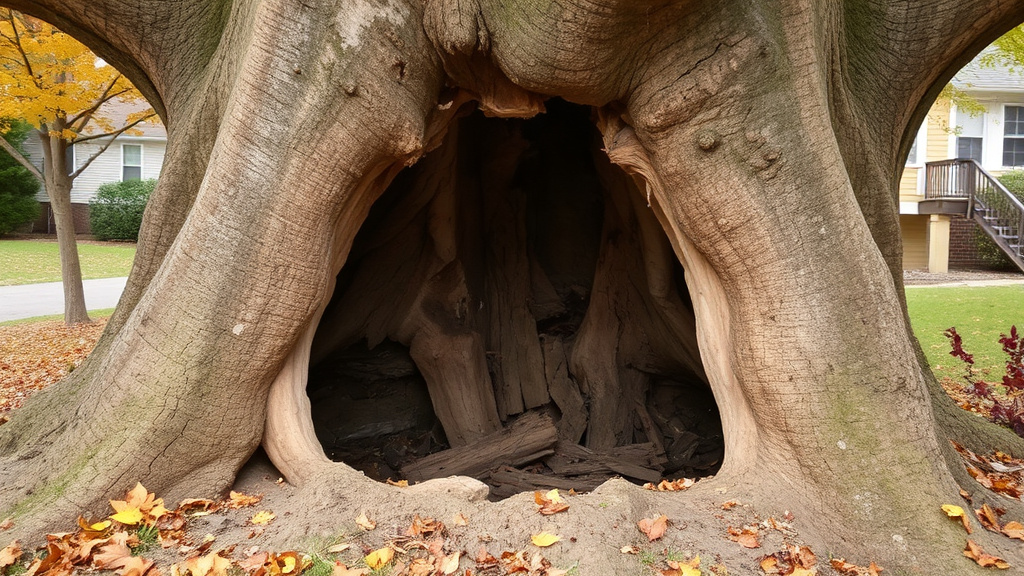
How decay gets in
Healthy wood has defenses. When a tree is wounded, it seals the area off from the sound wood around it. Decay fungi take advantage of the wounds that the tree cannot seal in time: a limb torn off in a storm, a deep mower scar, a pruning cut made flush with the trunk, or a root cut during digging. Once the fungus is inside, it spreads along the heartwood, and a tree can live for years with a growing cavity.
Outside clues to inside trouble
Hollow trees give hints. A cavity or a hole at the base or in a fork is the plain one. Others are less obvious. A trunk that has a sudden bulge or a flat, sunken area may be covering a cavity. Bracket fungi growing from the bark show that decay is established. Sawdust-like material at the base, or small holes made by insects, point to wood that is already being broken down. A crown that thins from the top, or branches that die back one at a time, may be a response to the tree losing its ability to move water.
Tapping with a mallet is a fair first test. Solid wood rings, and hollow wood gives a dull sound. It is not exact, and it should not replace an inspection by someone with training, but it tells you where to point the camera.
When a hollow tree is fine
A hollow tree is not always a hazard. Trees are strong because their wood is arranged in a ring, and a tree with a thick wall of sound wood around a cavity can stand safely for decades. What counts is the thickness of that wall relative to the width of the trunk, whether the cavity is open or closed, and whether the tree has a lean or heavy limbs that add load.
- A thick wall of solid wood around the cavity is a good sign.
- A thin wall, or a cavity that reaches the bark, is a warning.
- Fungus on the wall means that decay is active.
- A lean toward a building raises the stakes.
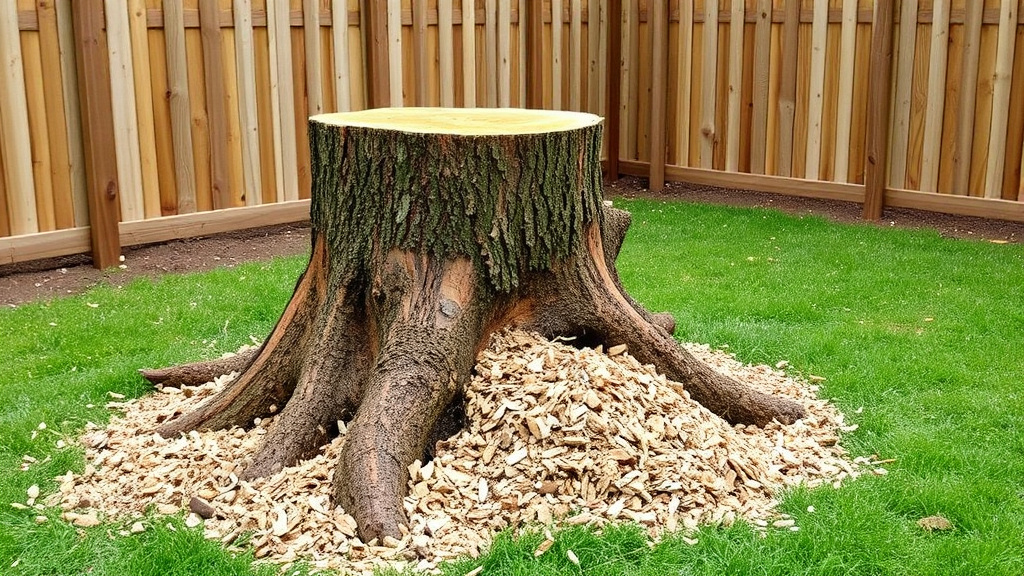
If the tree has to come down
When an inspection shows that a tree cannot be saved, the stump becomes the next question. Stump grinding is the most common way to finish the job, and it is a specialty. G&V Tree Service, which has worked in Northern Virginia since 2001, notes that grinding is typically not included in the price of a removal but is an important and affordable add-on. The company says very large stumps with deep spreading roots are beyond what home equipment can handle, and it has small grinders that can fit through a narrow backyard gate. Pulling a stump with a chain and a car bumper, in its words, simply does not work.
Before a grinder arrives, it helps to know what lies underneath. An earlier article, what to handle after a tree comes down in Burke, covers the stump, the lawn and the paperwork. If another tree on the lot may have to come down, the piece on how North Springfield homeowners plan a safe tree removal walks through the steps.
Why species and age matter
Some trees tolerate internal decay better than others, and some decay faster. Old maples and silver maples with large pruning wounds can rot from the inside out, while oaks often compartmentalize the damage and hold up longer. Age also changes the picture, because a tree that was sound at thirty can carry decades of small wounds at seventy. This is why a second look every year or two is more useful than one dramatic inspection, and why a record of dated photographs is a real help to whoever comes to look at the tree.
A short list for the next walk-around
On a dry day, walk around each large tree once. Look at the base, the forks and the points where old limbs were removed. Take a photograph of anything odd and date it. If the same spot looks worse a month later, call someone.
Pohick Regional Library is a good starting point for the directions below to the G&V office in Springfield.
G&V Tree Service Inc · 6434 Brandon Ave, Suite 204, Springfield, VA 22150 · (703) 569-2570